

DIY vs Managed BIMI
BIMI is straightforward when the dependencies are already under control.
DIY BIMI suits organizations with stable DMARC enforcement, an eligible logo, DNS and hosting access, and an accountable project owner. Managed BIMI adds value when a specialist helps coordinate unresolved dependencies and work across teams.
Readiness → Eligibility → CA Validation → Deployment → Lifecycle
Brand Indicators for Message Identification (BIMI) lets a sending domain publish a brand logo that supported mailbox providers may display beside authenticated email. Implementing it involves more than purchasing a certificate.
This guide compares the operating models for a certificate-backed BIMI deployment using a Verified Mark Certificate (VMC) or Common Mark Certificate (CMC). Gmail requires one of these certificates. Some mailbox providers support self-asserted BIMI without a mark certificate, so a certificate is not a universal requirement of the standard.
Internal owners prepare the domain and logo, respond to the issuer, publish the assets and DNS record, and track renewal.
The provider helps organize readiness, evidence requests, deployment, and lifecycle tasks within the agreed service scope.

DigiCert · GlobalSign · Sectigo
1 workflow
Readiness → Renewal
We work on the implementation around the certificate—not only the certificate transaction.
VMCcerts connects BIMI readiness, DMARC visibility, VMC/CMC eligibility, multi-CA selection, SVG preparation, validation coordination, deployment guidance and renewal management. Certificate issuance remains independently controlled by the Certificate Authority.
Before Choosing DIY or Managed, Check Your BIMI Readiness
Readiness changes the DIY-versus-managed decision more than the certificate purchase itself. A domain that already has mature email authentication and an eligible brand asset starts from a very different place than a domain still discovering legitimate sending sources or deciding whether its logo fits a VMC or CMC route.
| Readiness area | What must be established | Typical owner / key handoff |
|---|---|---|
| Email authentication | Legitimate sending services are identified and have SPF and DKIM configured. Messages pass DMARC through aligned SPF or DKIM. | Email / security confirms sending-source coverage and authentication readiness with the project owner. |
| DMARC enforcement | DMARC uses p=quarantine or p=reject at pct=100 on the organizational domain and applicable subdomains. Legitimate traffic is reviewed before enforcement. | Email / security coordinates policy changes with IT and any sending-service owners. |
| Logo asset | The approved logo and design source files are available for SVG Tiny PS (Portable/Secure) preparation. | Brand/design supplies the correct artwork to legal and the implementation owner. |
| Mark eligibility | The logo fits the selected VMC or CMC route, with the trademark or prior-use evidence required by the issuer. | Legal / brand supplies rights evidence and answers issuer questions through the application contact. |
| Organization and domain | Legal entity information, domain control and authorized applicant contacts can be independently verified by the CA. | Legal / IT provides evidence; procurement connects commercial approval and the order to the project owner. |
| DNS and hosting | Required assets can be hosted publicly over HTTPS and referenced in the BIMI DNS record. | IT / DNS / web publishes approved assets and records, then coordinates retrieval and test-message checks. |
| Project and lifecycle ownership | An accountable owner coordinates evidence, deployment, testing, changes and renewal. | An internal owner or managed specialist routes requests and assigns tasks. The CA independently controls validation and issuance. |
Start with the domain, not the certificate.
Check the current BIMI signals before deciding whether the next step is DMARC, eligibility, issuance or deployment.
DIY vs Managed BIMI: Readiness Matrix
A useful DIY-versus-managed decision is based less on company size than on how many dependencies are already controlled. This matrix is a planning framework: it does not determine certificate eligibility, but it helps identify where coordination effort is likely to sit.
| Project condition | DIY suitability | Potential value of managed help | Why |
|---|---|---|---|
| DMARC enforced, one domain, experienced internal email/DNS owner | High | Low–Medium | Most technical prerequisites and ownership are already established. |
| DMARC enforced, but this is the organization’s first BIMI deployment | Medium–High | Medium | The technical base is strong; certificate validation and cross-team handoffs are the unfamiliar part. |
| DMARC not yet at enforcement or legitimate senders are still being discovered | Low initially | High | Authentication readiness must be resolved before the certificate becomes the priority. |
| Multiple brands, domains or legal entities | Medium–Low | High | More owners, assets, records and lifecycle events have to stay coordinated. |
| Mark route and logo eligibility are already clear | High | Medium | One of the main non-technical decision points has already been resolved. |
| VMC/CMC route or supporting evidence is uncertain | Medium | High | Eligibility should be assessed before a purchase path is chosen. |
| Experienced MSP already owns DMARC, DNS, certificate deployment and CA coordination | High | Low | The organization may already have the managed layer it needs. |
| No single internal owner for the project | Low–Medium | High | Cross-team handoffs become the main source of project overhead. |
BIMI Implementation: Before, During, and After Certificate Issuance
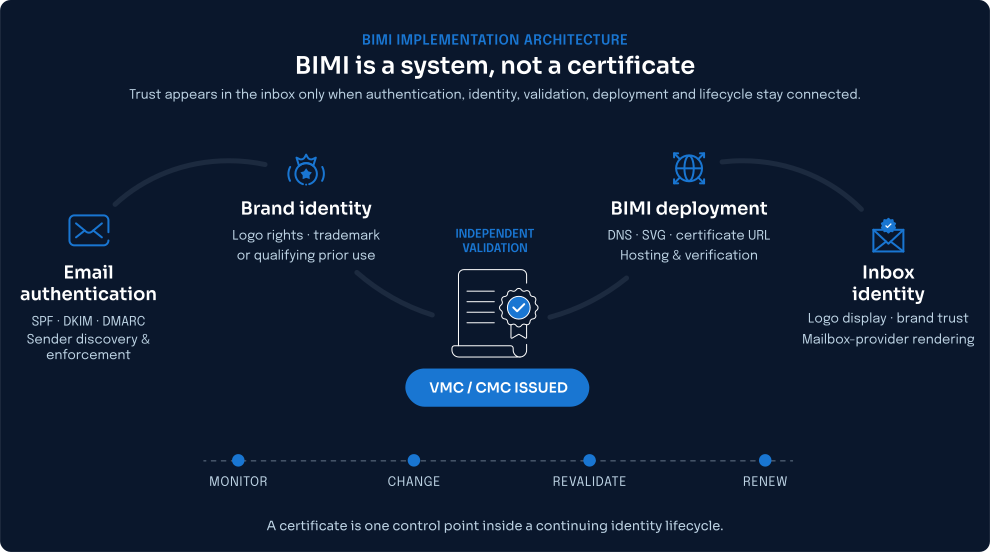
The key implementation insight: VMC or CMC issuance sits inside a wider system. Authentication and identity preparation happen before issuance; deployment, monitoring and renewal continue afterward.
One of the easiest mistakes in a first BIMI project is treating certificate issuance as the finish line. In a certificate-backed deployment, issuance is better understood as a milestone in the middle of a broader lifecycle.
Prepare
Authentication readiness, DMARC enforcement, logo preparation, mark eligibility, organization/domain information and selection of the appropriate certificate path.
Validate & Issue
Application submission, CA verification of the organization, domain and rights to the mark, plus any evidence or clarification requested during validation.
Deploy & Maintain
Host the required assets, publish the BIMI record, verify retrieval and display, continue DMARC monitoring, and manage certificate renewal and later changes.
The Certificate Authority independently controls validation and issuance. A managed provider cannot waive a CA requirement or guarantee approval. Its role in the BIMI certification journey is to help prepare the prerequisites and evidence, coordinate validation responses, and support deployment after issuance.
DIY BIMI Implementation: Is It Straightforward or Complex?
There is no useful universal answer. The same standard can be a small internal project for one organization and a multi-team coordination exercise for another.
Prerequisites already exist
DMARC is enforced, sending sources are understood, the logo/mark route is clear, DNS access is internal and the team is comfortable with certificate validation.
Several owners are involved
The logo needs work, the mark route needs confirmation, DMARC was only recently enforced, or legal, brand and IT need to coordinate before application.
Dependencies multiply
Multiple brands/domains, uncertain sending sources, licensing or parent/subsidiary structures, unclear logo rights, or no internal experience with CA validation and BIMI deployment.
The value of managed assistance depends on how much preparation and coordination your team needs. If the prerequisites already exist and one capable owner can coordinate the work, DIY may be the sensible choice. Managed assistance becomes more valuable as dependencies and handoffs increase.
4 Factors That Affect BIMI Complexity
BIMI complexity is rarely one difficult technical operation. It is the combined effect of four kinds of dependency:
- Technical: DMARC enforcement, DNS access, HTTPS hosting and a compliant SVG.
- Identity: the logo, the rights to it and the evidence the CA may request.
- Organizational: who owns each task, who can answer the CA and who can approve the purchase.
- Lifecycle: renewal, revalidation and changes to the logo, domain or sending setup.
Who Owns BIMI Inside an Organization?
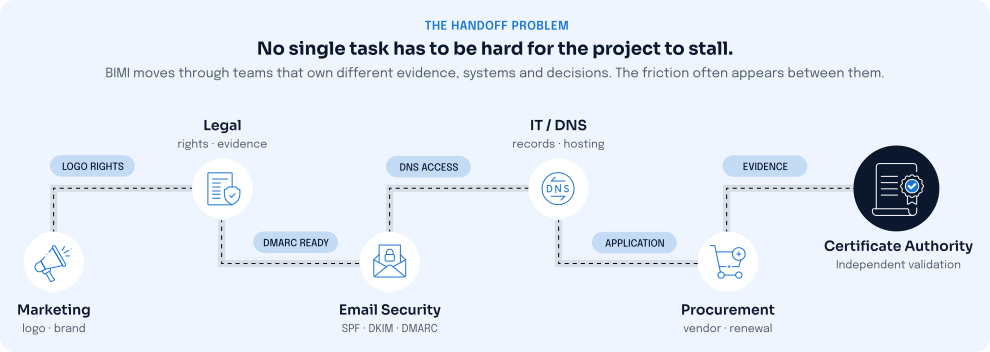
Where managed service creates value: not by bypassing technical or CA requirements, but by coordinating evidence, ownership, dependencies and responses across the project.
As the readiness and ownership table shows, no single department naturally owns every BIMI dependency. The brand team controls the logo, legal may control evidence of rights to the mark, security controls authentication, IT controls DNS and hosting, procurement may own the purchase, and the CA makes the independent issuance decision. An internal project owner or managed specialist coordinates these responsibilities, while each team retains control of its own assets and systems.
The Hardest Part of BIMI May Be the Handoffs
For many first-time projects, the individual tasks are not the problem. The handoffs are.
A brand team may provide the logo, but legal needs to confirm the rights position. Security may confirm that DMARC is enforced, but IT still owns the DNS change. Procurement may complete the certificate purchase, but the CA’s evidence request needs an answer from legal or an authorized organizational contact. After issuance, the project returns to IT for hosting and DNS, then back to the project owner for verification and lifecycle tracking.
That creates a practical failure mode: each request can be technically routine while still waiting on someone who does not know why it matters, what the next dependency is, or what the CA is asking for. The value of management is therefore less about “doing a difficult technical task” and more about maintaining context across the sequence.
Common Causes of BIMI Deployment Delays
The delays that matter most are usually readiness or ownership gaps rather than the certificate order itself. Common examples include:
- Unknown sending sources. DMARC reports reveal services that have not been accounted for. Review legitimate traffic before tightening enforcement.
- Authentication gaps behind a published DMARC record. Some legitimate messages still fail alignment. A record alone does not establish operational readiness.
- Logo preparation or evidence gaps. The approved artwork needs SVG preparation or clarification of its trademark or prior-use evidence. Brand and legal need to resolve this together.
- A certificate route chosen too early. Eligibility questions send the project back to legal or brand owners. Confirm the route before ordering.
- CA requests reach the wrong contact. The buyer cannot supply the required evidence. Name the authorized contacts and route requests to the right owner.
- Issuance has an owner; deployment does not. DNS, hosting and verification remain unassigned. Plan those handoffs before the certificate arrives.
These are not reasons to avoid DIY. They are reasons to assign ownership before the project starts. An experienced internal team can handle all of them; a managed provider is useful when the organization would rather centralize that coordination.
Your First BIMI Project: Unknowns Matter More Than Tasks
Teams implementing BIMI for the first time are often technically capable. What they lack is precedent: which evidence the CA may request, who internally can answer it, whether the current logo follows the expected certificate route, what remains after issuance, and who will own renewal later. On later deployments, teams can draw on the workflow and ownership established during the first project. On the first, discovering the workflow can take more effort than executing any individual task.
This is where experience has practical value. It does not replace CA validation or internal authority; it reduces the amount of workflow the organization has to discover while the project is already in motion.
DIY BIMI: What Your Team Needs to Own
DIY BIMI requires clear ownership for each workstream, from preparation through renewal. The BIMI certificate process is one part of that responsibility.
Authentication and technical readiness
Your email/security team needs visibility into legitimate senders, working SPF and DKIM authentication, DMARC alignment and a safe enforcement posture. The goal is not simply to have DNS records present; it is to know that legitimate mail will continue to authenticate when BIMI prerequisites are enforced.
Brand and eligibility
Your organization needs the correct logo asset and evidence of its right to use it. A Verified Mark Certificate (VMC) generally requires a qualifying registered trademark that matches the logo. A Common Mark Certificate can cover a logo without a qualifying registered trademark, provided it meets the CMC prior-use requirements. Confirm the logo’s eligibility and supporting evidence against the selected issuer’s current requirements before applying.
Certificate validation
Someone needs to choose the Certificate Authority, submit accurate organization/domain information, coordinate authorized contacts and respond to CA evidence requests. The CA still makes the independent validation decision.
Deployment and lifecycle
After issuance, someone must own asset hosting, BIMI DNS publication, technical verification, mailbox-provider testing, DMARC monitoring and the renewal calendar. A later change to the logo, domain, legal organization or sending architecture can also create new work.
A first BIMI deployment is often the point at which an organization discovers that “certificate owner,” “DNS owner,” “email owner” and “brand owner” are four different people. DIY works best when one person has authority to coordinate all four.
What Does “Managed BIMI” Mean?
“Managed” is not a standardized service scope. Two providers can both use the term while owning very different parts of the project. Understanding certificate provider roles helps clarify which responsibilities remain with your team and what each offer includes.
Certificate Authority / issuer
Validates the applicant and mark under its policies and issues the certificate. Some issuers also provide tooling or implementation guidance. Scope outside certificate validation varies.
Ask: What implementation and post-issuance assistance is included with this purchase?
Certificate reseller
Facilitates certificate procurement and commercial access. Some resellers add substantial technical/validation support; others are primarily transactional. Check the actual service scope.
Ask: Who handles readiness, SVG preparation, validation coordination and deployment?
MSP / email-security provider
May already own DMARC, DNS or email authentication. Some can coordinate the entire BIMI workflow. If your existing MSP has genuine mark-certificate and deployment expertise, an additional provider may be unnecessary.
Ask: Do you also cover Mark Certificate eligibility, CA validation and post-issuance BIMI verification?
Managed BIMI specialist
Coordinates the agreed scope across readiness, certificate-route assessment, logo preparation, CA validation, deployment and lifecycle. Its value comes from maintaining context across team handoffs.
Ask: Which CAs are supported, what is included, and what remains our responsibility?
BIMI Service Scope: Certificate Purchase vs Project Management
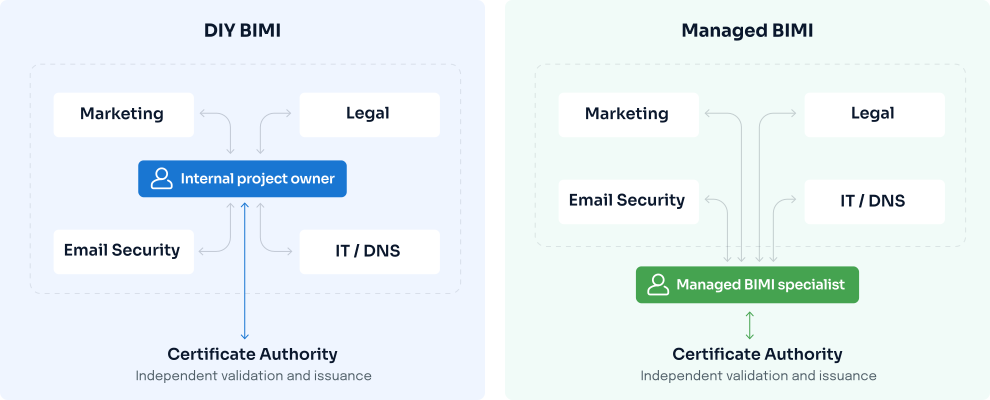
DIY and managed BIMI do not use different standards. The difference is primarily the operating model: who coordinates readiness, evidence, validation, deployment and lifecycle work.
Rather than assuming what a direct CA, reseller or MSP includes, ask who owns each responsibility in the actual offer you are evaluating.
| Responsibility | Certificate-focused engagement | Full managed BIMI engagement |
|---|---|---|
| CA validation and issuance | Performed by the CA | Performed by the CA |
| BIMI readiness review | Customer or provider, depending on scope | Expected managed responsibility |
| DMARC readiness / source visibility | Customer or separate service, depending on scope | Included or coordinated if offered |
| VMC/CMC route assessment | Varies | Expected managed responsibility |
| SVG preparation | Customer or varies | Included if stated in managed scope |
| Evidence / validation coordination | Customer or varies | Expected managed responsibility |
| DNS / hosting deployment | Customer or varies | Assisted or managed according to scope |
| Post-issuance verification | Customer or varies | Expected managed responsibility |
| DMARC reporting after go-live | Separate or varies | Included only if explicitly offered |
| Renewal / revalidation tracking | Customer or provider, depending on scope | Expected managed lifecycle responsibility |
A CA, reseller or MSP may provide implementation assistance alongside the certificate. Confirm the responsibilities covered by the actual service agreement.
DIY vs Managed BIMI: Compare Total Project Costs
A DIY project does not automatically mean “certificate cost only.” A managed project does not automatically mean “certificate price plus a large consulting fee.” The useful comparison is total cost for the work your organization actually needs.
That can include internal staff time across email/security, IT, legal and brand; DMARC reporting or remediation; SVG preparation; time spent responding to CA validation; external MSP/consulting hours; deployment troubleshooting; and future renewal/revalidation work.
Can Managed BIMI Speed Up Deployment?
Managed BIMI can reduce avoidable delays through better preparation and coordination, but it cannot guarantee a shorter overall timeline.
Managed assistance cannot bypass CA validation, accelerate an external trademark-office process, guarantee certificate issuance, force a mailbox provider to display a logo, or eliminate DNS propagation. Those dependencies remain outside the managed provider’s control.
Where management can save time is in avoidable rework: starting an application before prerequisites are ready, using an unsuitable logo asset, selecting the wrong certificate route, sending incomplete evidence, losing context between internal teams, or treating issuance as complete before DNS/hosting verification has been finished.
Certificate Issuance Does Not Complete Your BIMI Deployment
Post-issuance work deserves its own checkpoint because it is where certificate procurement and actual BIMI deployment separate.
- The required logo and certificate assets must be available at the expected HTTPS locations.
- The BIMI DNS assertion must reference the correct assets.
- DNS and asset retrieval need to be verified from outside the organization.
- Test messages must still satisfy the authentication and alignment requirements expected by participating mailbox providers.
- DMARC reporting remains useful after go-live because the sending environment can change.
- The Mark Certificate has a lifecycle: expiry, renewal/revalidation and future brand/domain changes need an owner.
The BIMI Group itself notes that participating mailbox providers apply their own criteria for whether a logo is displayed. A technically correct deployment is therefore something to verify and maintain, not a one-time purchase that should be assumed to render identically everywhere.
When DIY BIMI Makes Sense
DIY BIMI is a strong option when the prerequisites are already mature and the organization has one accountable owner. In practical terms, that usually means DMARC enforcement is stable, legitimate sending sources are understood, the logo/mark path is clear, DNS and hosting are controlled internally, and the team is comfortable dealing directly with CA validation and later renewal.
An organization in this position may need little more than the certificate itself and a precise implementation reference. Paying another party to coordinate work the team already owns would add limited value.
When Managed BIMI May Be Worth It
Managed assistance becomes more compelling when the project has uncertainty rather than simply tasks: it is the first implementation; DMARC is not yet safely at enforcement; sending sources are not fully mapped; VMC-versus-CMC eligibility is unclear; logo and mark evidence need review; multiple brands/domains or legal entities are involved; internal teams have never handled Mark Certificate validation; or no internal owner has been assigned to coordinate deployment and renewal.
It can also be useful when the organization already has capable specialists but does not want marketing, legal, email security, IT and procurement to coordinate the CA process independently. In that case, the managed provider is primarily a project owner with BIMI-specific context.
Should your team DIY BIMI—or use managed help?
Share your domain, organization and logo details. A VMCcerts team member reviews DMARC status and logo eligibility, then sends a readiness report with the likely VMC or CMC path and a step-by-step roadmap.
Free report from a VMCcerts team member.
What’s Your Current BIMI State?
Choose your next step
Not Ready for BIMI Yet?
Start with DMARC to identify legitimate sending sources and move toward enforcement.
DMARC-Ready, but Path Unclear?
Confirm the likely VMC/CMC route and the steps still needed before you apply.
Already Have a Certificate?
Plan certificate renewal, required revalidation, or a change of provider.
VMCcerts Includes Guided Support with Your BIMI Certificate
VMCcerts combines certificate options with human-assisted BIMI implementation support. We help identify readiness gaps, determine the appropriate VMC/CMC route, compare supported Certificate Authority options, prepare the logo asset, coordinate validation, guide deployment and track renewal.
Implementation-first
Readiness and eligibility are reviewed before the certificate route and issuer are selected.
Multi-CA choice
DigiCert, GlobalSign and Sectigo can be considered against eligibility, requirements and commercial fit.
Human-assisted validation
We coordinate CA evidence requests and responses across your brand, legal, security and IT teams.
Deployment and renewal support
Support continues through deployment checks, expiry tracking and renewal coordination.
Implementation support is included with your certificate.
You pay for the VMC or CMC certificate. Guided implementation support is included at no separate fee and covers:
- eligibility review;
- DMARC configuration setup;
- SVG logo formatting;
- CA validation coordination; and
- BIMI DNS setup guidance.
Full DMARC enforcement and ongoing reporting are separate services.