
Why DMARC Matters

Without DMARC, Anyone Can Send Email as Your Brand

Domain impersonation is the most common entry point for phishing and business
email compromise. DMARC enforcement closes that door.

Stop Domain Impersonation

Stop Domain Impersonation

Without DMARC enforcement, anyone can send email that appears to come from your domain. Customers, partners, and staff are exposed to convincing fakes that damage your brand trust with every successful attack.
Full Visibility Into Who Sends as You

Full Visibility Into Who Sends as You

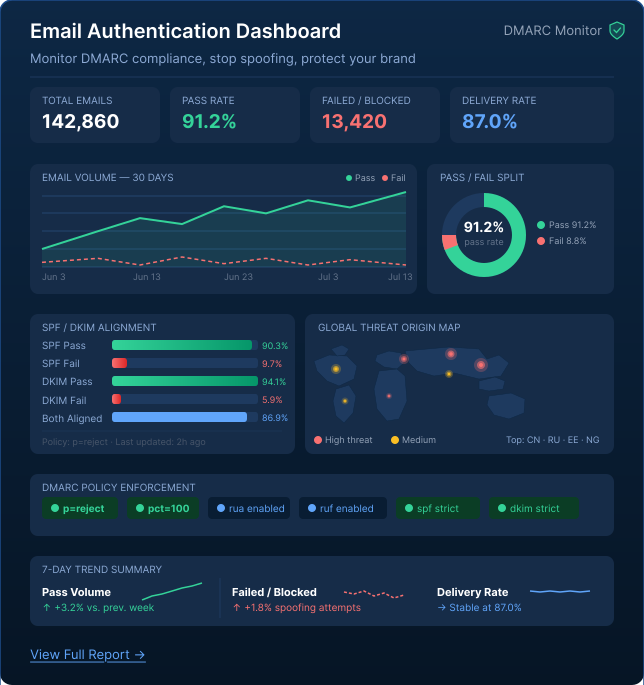
DMARC aggregate reports (RUA) show you every source sending email from your domain — authorized senders, misconfigured systems, and active impersonators — so you can act on real data.
BIMI Logo Display Activation

BIMI Logo Display Activation

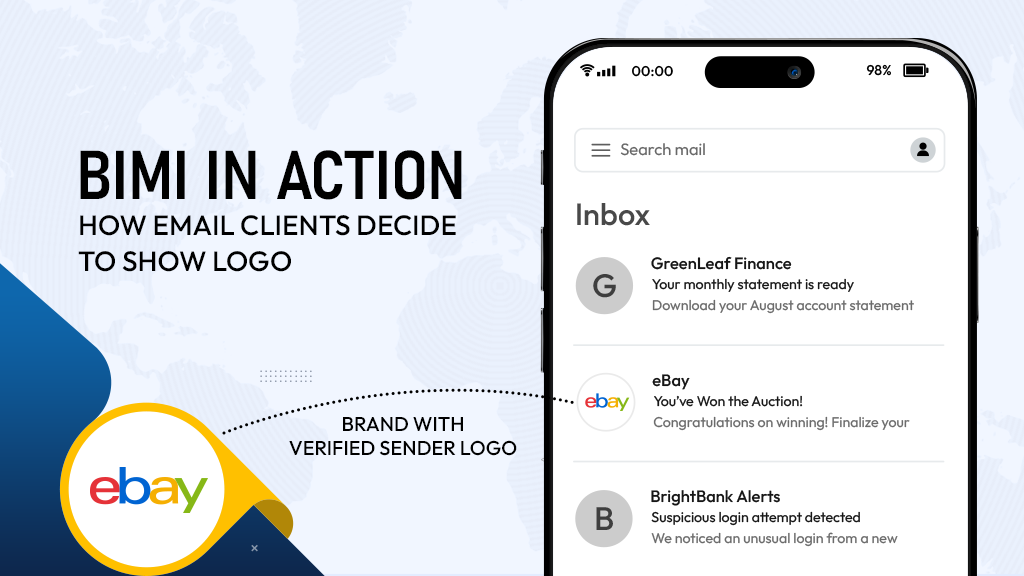
DMARC at p=reject or quarantine with pct=100 is the mandatory prerequisite for BIMI logo display with VMC or CMC. Without it, verified inbox branding cannot proceed across supported email clients.
Protect Email Deliverability

Protect Email Deliverability

When impersonators send spam or phishing from your domain, your domain’s reputation suffers — affecting deliverability for your real campaigns. DMARC enforcement protects the reputation you have built.
Compliance & Regulatory Alignment

Compliance & Regulatory Alignment

Google and Yahoo now require DMARC for bulk email senders. PCI DSS v4.0 references email authentication requirements. DMARC enforcement keeps you ahead of evolving compliance standards.
Proven Across High-Stakes Industries

Proven Across High-Stakes Industries

Banks, insurance companies, and financial institutions were among the first to enforce DMARC — driven by fraud sensitivity and regulatory pressure. The same standard now applies across every sector that sends transactional email.
Service Plans

Expert DMARC Implementation Plans

Choose the plan that matches your domain complexity and timeline.
All plans include end-to-end expert-led setup and validation.

Starter

DMARC Setup & Configuration

For organizations that need DMARC, SPF, and DKIM correctly configured from the start. We handle the full DNS setup and deliver it ready for enforcement.

$49/one-time
  • SPF record setup and validation
  • DKIM configuration across all sending sources
  • DMARC record created and published
  • Domain spoofing risk assessment
  • DNS record testing and verification
  • Audit report with recommendations

Get Started

MOST POPULAR
Enforcement

Full DMARC Enforcement & Reporting

Our most popular DMARC implementation plan. End-to-end DMARC management with continuous monitoring, reporting, and enforcement across all sending sources.

$199/domain
  • Full SPF record setup across all senders
  • DKIM signing configured and validated
  • DMARC progressed to p=reject, pct=100
  • RUA & RUF reporting configured
  • DNS record validation and testing
  • VMC and BIMI ready certification
  • 30-day post-deployment support

Get Started

Enterprise

Multi-Domain DMARC Management

For organizations with multiple domains, complex sending infrastructure, or global email programs requiring a managed DMARC solution.

Custom
  • Unlimited domain coverage
  • Complex ESP and CRM integration review
  • Subdomain policy management
  • Ongoing monitoring and reporting dashboard
  • Quarterly security review calls
  • BIMI and VMC implementation included
  • SLA-backed response times
  • Onboarding call and custom project plan

Request a Quote

Implementation Process

From Assessment to DMARC Enforcement in 5 Steps

We guide each stage of implementation — from sender discovery and DNS updates to report analysis and policy enforcement.

1
Domain & Sender Audit
Your current SPF, DKIM, and DMARC posture is reviewed. Known sending sources are mapped across marketing, billing, CRM, and support systems.
2
SPF & DKIM Alignment
SPF design is validated and DKIM signing confirmed or enabled where required. Authenticated mail streams are aligned across identified senders.
3
DMARC Monitoring & Analysis
DMARC is published at p=none with reporting enabled. Aggregate reports are analyzed to identify legitimate sources, misconfigurations, and unauthorized traffic.
4
Policy Progression
Once identified, sending sources are validated and aligned, policy is progressed from monitoring through quarantine toward p=reject with controlled, staged rollout.
5
Enforcement & BIMI Readiness
With enforcement in place, your domain is protected against direct spoofing. Your sending infrastructure is now positioned for BIMI and VMC or CMC.

Why VMCcerts

Expert DMARC Guidance at Every Step

DMARC implementation done wrong creates deliverability problems.
Done right, it protects your domain and unlocks your brand’s inbox identity.

Identify Authorized Senders

Identify Authorized Senders

We identify all known systems sending email for your domain – from ESPs and CRMs to billing and marketing tools – before any DNS updates. No legitimate emails disrupted.

Fast Path to Enforcement

Fast Path to Enforcement

Most clients reach p=reject within a few weeks. Our phased approach moves from monitoring to quarantine to full rejection, without deliverability impact at any stage.

DMARC Report Interpretation

DMARC Report Interpretation

We translate aggregate reports into plain-language action items. You will always know what each source is doing and whether any new impersonation activity has appeared.

End-to-End DNS Support

End-to-End DNS Support

Full DNS configuration support from SPF and DKIM to DMARC TXT records – prepared for your infrastructure and applied with or alongside your team. Compatible with all major DNS providers.

BIMI Pathway Included

BIMI Pathway Included

Every DMARC engagement includes an assessment of your VMC or CMC eligibility. If you are BIMI-ready after enforcement, we handle the full BIMI certificate workflow at no additional consultation fee.

24/7 Expert Support

24/7 Expert Support

Continuous specialist support throughout your DMARC implementation – available at every stage, no matter where you are in the process – monitoring, enforcement, and beyond.

FAQ

Got questions about DMARC?

Basics & Buying Decision

What is DMARC and why is it important?

DMARC is an email authentication protocol that protects your domain from phishing, spoofing, and impersonation attacks. It works alongside SPF and DKIM to help mailbox providers identify legitimate email senders and block unauthorized messages pretending to come from your domain.

What’s the difference between SPF, DKIM, and DMARC?

SPF specifies which servers are allowed to send email for your domain. DKIM adds a cryptographic signature that verifies the message was not altered in transit. DMARC ties both together by enforcing authentication policies and telling mailbox providers how to handle emails that fail verification. Inspect DMARC record

Why is DMARC required for BIMI Certificates?

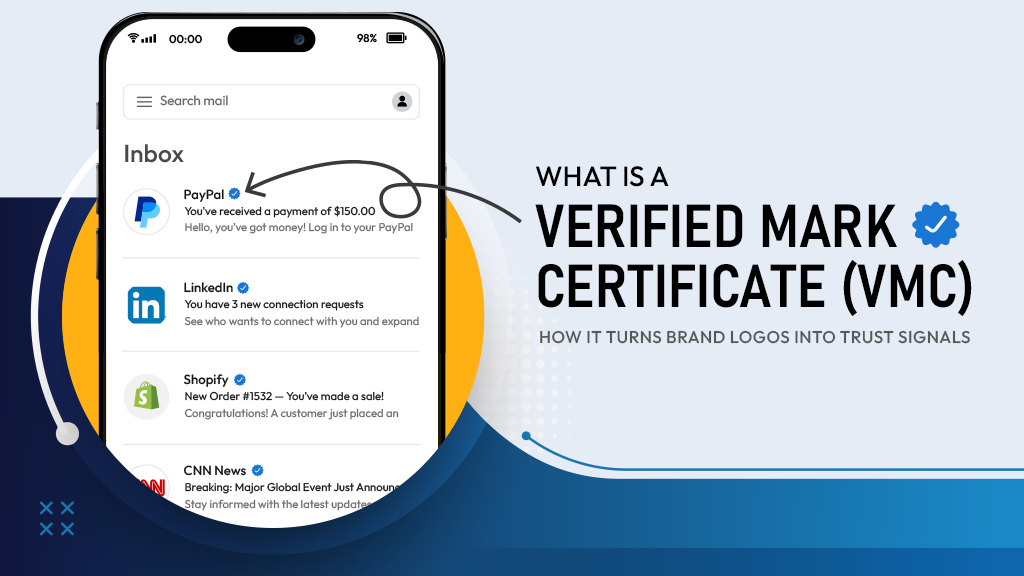
DMARC enforcement is mandatory for BIMI logo display in Verified Mark Certificate (VMC) and Common Mark Certificates (CMC). Mailbox providers and Certificate Authorities require domains to operate at p=quarantine or p=reject before verified logos can appear in supported inboxes.

What happens to my domain if I don't have DMARC?

Without DMARC, your domain is open to impersonation. Attackers can send phishing emails, business email compromise attempts, and fraudulent messages that appear to come directly from your domain — and recipients have no technical way to detect they're fake.

Will DMARC enforcement affect email delivery?

DMARC enforcement only affects emails that fail authentication checks. When configured correctly, legitimate email delivery continues normally while unauthorized or misconfigured senders are blocked.

Eligibility & Technical Readiness

Do I need DMARC if SPF and DKIM are already configured?

SPF and DKIM alone do not fully protect your domain from impersonation. DMARC is what enforces authentication and instructs receiving servers to quarantine or reject fraudulent emails that fail validation checks.

How long does it take to reach p=reject enforcement?

Most domains reach full enforcement within 2–4 weeks. The timeline depends on how many sending sources need to be configured and aligned. Organizations with complex infrastructure — multiple ESPs, CRM tools, and third-party senders — may take 6–8 weeks. We always monitor through at least one full weekly reporting cycle before progressing to the next policy level.

Will moving to p=reject break my email delivery?

Not if it's done correctly. Our process identifies every sending source and ensures all legitimate mail is SPF and DKIM aligned before policy moves to p=reject. Done with the right preparation, the transition is seamless. Done prematurely, it causes deliverability issues — which is exactly why the sender audit step comes first.

What is the difference between p=none, p=quarantine, and p=reject?

p=none monitors authentication results without taking any action — useful for the initial visibility phase. p=quarantine sends failing messages to the spam or junk folder. p=reject blocks failing messages entirely, preventing them from reaching the recipient at all. BIMI and VMC require p=reject with pct=100 — full enforcement with no exceptions.

How does the DMARC implementation process work?

We follow a structured five-step process: domain and sender audit, SPF and DKIM alignment, DMARC monitoring and report analysis, staged policy progression, and final enforcement with BIMI readiness confirmation. Each stage is expert-led — we don't move to the next step until the current one is fully validated.

What is pct=100 and why does it matter?

pct=100 means your DMARC policy applies to 100% of emails that fail authentication — not a sample or percentage. BIMI requires pct=100 alongside p=reject. A policy set to a lower percentage is treated as partial enforcement and does not meet the BIMI specification requirements. Check BIMI score

Reporting & Visibility

What are DMARC aggregate reports (RUA)?

DMARC aggregate reports are XML-based reports sent by mailbox providers that show which servers are sending email from your domain and whether those messages passed SPF and DKIM authentication checks.

What are DMARC forensic reports (RUF)?

DMARC forensic reports provide detailed information about individual authentication failures. They help identify spoofing attempts, misconfigured systems, and suspicious email activity affecting your domain.

Can DMARC show who is sending email from my domain?

DMARC reporting provides visibility into every IP address and service attempting to send email using your domain identity, including legitimate senders and unauthorized sources.

How often should DMARC reports be monitored?

DMARC reports should be reviewed continuously, especially during deployment and enforcement transitions. Ongoing monitoring helps detect new sending sources, authentication failures, and emerging spoofing attempts.

Compliance & Industry Use

Does DMARC help with Google and Yahoo sender requirements?

Google and Yahoo now require DMARC for bulk email senders as part of their inbox policies. A domain without a DMARC record risks deliverability issues across both platforms.

Does DMARC help with compliance requirements?

DMARC supports email security requirements commonly associated with compliance frameworks such as HIPAA, GDPR, SOC 2, PCI DSS, and cybersecurity best practices for protecting domain identity.

Which industries benefit most from DMARC enforcement?

Banks, insurance companies, and financial institutions were among the first to enforce DMARC — driven by fraud sensitivity and regulatory pressure. Healthcare organizations use it to protect patient communications and support HIPAA requirements. E-commerce, SaaS, and any brand that relies on transactional email benefits from the domain protection and deliverability assurance DMARC provides.

Pricing, Plans & Support

How much does DMARC setup cost?

DMARC setup starts at $49 for the Starter plan, which covers SPF, DKIM, and DMARC configuration, DNS record setup, domain spoofing risk assessment, and a full audit report.

What is included in the DMARC Enforcement plan?

The Enforcement plan covers everything needed to take your domain from zero to full p=reject enforcement — SPF and DKIM setup across all sending sources, DMARC progression to p=reject with pct=100, RUA and RUF reporting configuration, DNS record validation, VMC and BIMI readiness certification, and 30 days of post-deployment support. It's our most comprehensive single-domain plan and the one most organizations need. Request a DMARC quote

Do you support agencies and MSPs?

Yes. VMCcerts supports agencies, MSPs, cybersecurity firms, and IT providers with white-label DMARC deployment assistance, bulk pricing, centralized management support, and partner onboarding.

What support is included after DMARC is deployed?

The Enforcement plan includes 30 days of post-deployment support. Enterprise clients receive SLA-backed response times, an ongoing monitoring and reporting dashboard, and quarterly security review calls. All plans include 24/7 specialist support throughout the implementation process — not just at the start. Talk to the VMCcerts team

Email Client Support

Where DMARC Authentication Takes Effect

DMARC enforcement protects your domain across major email providers.
BIMI logo display activates in supported clients once VMC or CMC is in place.